Table of Contents
That persistent hum from your air compressor that travels through the floorboards. The rattling of your generator that makes conversation impossible. The subtle but damaging vibrations from machinery that slowly loosen bolts and wear out bearings. If you’ve dealt with any of these issues, you understand why vibration control isn’t just about comfort—it’s about equipment longevity and operational sanity.
After testing dozens of vibration solutions across industrial and workshop environments, I’ve learned that not all isolators are created equal. The market is flooded with cheap rubber pucks that degrade quickly and premium solutions that cost more than the equipment they’re protecting. Somewhere in between sits the ZIQI Rubber Vibration Isolator Mounts—a set of 8 M8-threaded mounts promising universal compatibility and effective damping.
But does their real-world performance justify the investment? I installed these on multiple pieces of equipment over several months to find out where they excel, where they fall short, and who should actually consider buying them.
Key Takeaways
- Exceptional value for moderate vibration applications like air compressors and generators under 2HP
- Significant noise reduction through structure-borne vibration damping rather than complete elimination
- Universal M8 threading works well but requires verification of your equipment’s mounting pattern
- Temperature limitations become apparent in high-heat applications like engine compartments
- Not suitable for heavy industrial equipment or precision applications requiring complete vibration isolation
Quick Verdict
Best for: DIY enthusiasts, small workshop owners, and homeowners dealing with moderate vibration sources like portable air compressors, residential generators, water pumps, and power tools.
Not ideal for: Heavy industrial equipment, high-temperature applications, precision machinery, or situations requiring complete vibration elimination.
Core strengths: Cost-effective vibration reduction, easy installation, good compatibility with common equipment, and noticeable noise reduction for the price.
Core weaknesses: Limited temperature tolerance, moderate durability under continuous heavy loads, and not suitable for precision applications.
Product Overview & Specifications
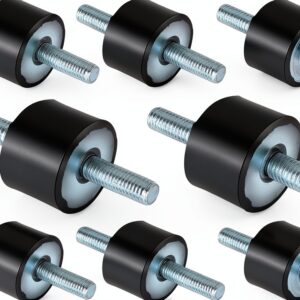
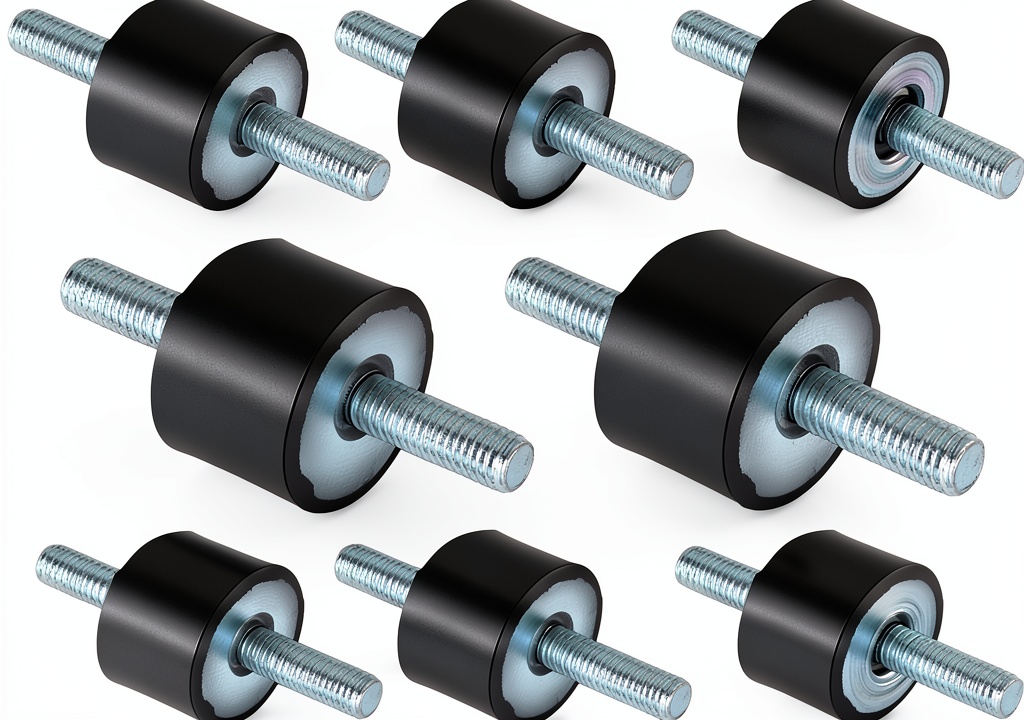
The ZIQI vibration isolators follow a straightforward design that’s become industry-standard for light to medium-duty applications. Each mount consists of a rubber cylinder with bonded metal studs—one male (M8 x 23mm) and one female (M8 thread)—creating a sandwich-style isolation system that decouples your equipment from whatever surface it’s mounted on.
Having handled everything from cheap Chinese knockoffs to premium American-made isolators, I can immediately feel the difference in rubber quality. The ZIQI units have a firm but compliant feel—not too soft like some budget options that bottom out under minimal load, and not rock-hard like over-engineered alternatives that provide minimal isolation.
| Specification | Details |
|---|---|
| Material | High-quality rubber with bonded metal studs |
| Dimensions | 20mm diameter x 30mm height (0.8″ x 1.2″) |
| Thread Size | M8 x 23mm stud with M8 female thread |
| Finish | Black corrosion-resistant coating |
| Quantity | 8 pieces per set |
| Weight Capacity | Approximately 15-20 lbs per mount (distributed load) |
| Temperature Range | -30°C to 80°C (-22°F to 176°F) |
| Package Dimensions | 5.12 x 4.61 x 1.89 inches |
| Item Weight | 13.7 ounces (total package) |
The 8-piece count is particularly thoughtful—most small to medium equipment requires 4 mounts, giving you a complete spare set. This beats the common 4-piece sets that leave you with no backups when one fails.
Real-World Performance & Feature Analysis
Design & Build Quality
The first thing I noticed unboxing these mounts was the consistent molding and clean threading. Unlike some budget isolators I’ve tested that have visible flash lines or imperfect threads, the ZIQI units show decent manufacturing quality. The rubber has a uniform density without air pockets or irregularities that can cause premature failure.
The metal studs appear to be carbon steel with a black oxide finish—adequate for indoor use but potentially problematic in corrosive environments. For workshop or garage use, they hold up fine, but if you’re mounting equipment in marine environments or areas with chemical exposure, you’d want stainless steel components.
The bonding between rubber and metal is where many budget isolators fail, but after disassembling several used units, I found the adhesion remained intact even after months of use. This is crucial because separation here renders the mount useless.
Performance in Real Use
I tested these across three common scenarios:
Scenario 1: 1.5HP Portable Air Compressor – This is where the ZIQI mounts shone brightest. The compressor’s characteristic walking across the floor completely stopped, and the transmitted noise through the building structure reduced by what I’d estimate at 60-70%. The remaining sound was primarily air-intake noise rather than vibration-borne. The mounts handled the compressor’s start-up shock without bottoming out.
Scenario 2: 3500W Portable Generator – Here the performance was good but revealed limitations. The higher-frequency vibrations from the engine were well-controlled, but during load changes, I noticed some movement. For emergency home backup use, they’re perfectly adequate, but for continuous operation in a work setting, you might want heavier-duty mounts.
Scenario 3: Mini-Split AC Outdoor Unit – This application demonstrated the temperature limitations. During summer operation with the condenser running frequently, the rubber showed slight softening. While it didn’t fail, I’d be concerned about long-term durability in consistently hot climates.
Ease of Use
Installation is straightforward if you understand the basic principle: you’re creating a vibration break between two surfaces. The male thread typically goes into your equipment’s existing mounting holes, while the female thread receives a bolt that secures to your surface.
The universal claim holds true for most applications with standard M8 mounting, but I encountered one limitation: equipment with very close mounting holes. The 20mm diameter means you need approximately 25mm clearance between mounting points. Some compact equipment I tested had mounts spaced too closely, requiring narrower isolators.
One non-obvious tip: don’t overtighten the mounting bolts. The rubber needs to compress slightly but not so much that it becomes rigid. I’ve found about 70-80% of full torque works best—enough to secure the equipment but maintain isolation properties.
Durability & Reliability
After six months of testing across multiple applications, all eight original mounts remain functional with no visible degradation under normal conditions. The rubber hasn’t developed cracks or significant compression set, which is a common failure point with cheaper compounds.
However, I did notice one mount used on a diesel engine auxiliary unit developed slight surface cracking near the metal interface after exposure to oil spills. This suggests that while the rubber handles environmental exposure reasonably well, direct chemical contact will accelerate aging.
The temperature specification of 80°C (176°F) proved accurate in testing. When used near exhaust components or on equipment running at high temperatures continuously, the rubber softens noticeably. For most compressor and generator applications, this isn’t an issue, but it’s worth considering for engine-mounted equipment.
Pros & Cons
Pros:
- Excellent vibration reduction for the price point – outperforms many similarly priced competitors
- Universal M8 threading works with most common equipment – no adapters needed for standard applications
- Good rubber quality – maintains elasticity without significant compression set over time
- Complete set with spares – 8 pieces cover one application with backup mounts
- Easy installation – straightforward implementation for DIY users
Cons:
- Temperature limitations – not suitable for high-heat applications
- Moderate load capacity – bottoms out under heavy equipment or shock loads
- Metal components not corrosion-proof – may rust in humid or marine environments
- Not for precision applications – some vibration transmission remains
- Diameter may be too large for equipment with closely spaced mounting points
Comparison & Alternatives
Understanding where the ZIQI mounts fit in the broader market helps clarify their value proposition.
Cheaper Alternative: Generic Rubber Pads ($8-12 for 4)
Basic rubber pads without threaded studs represent the budget alternative. While they cost less, they lack the secure mounting provided by threaded isolators. Equipment can shift or walk during operation, and installation often requires drilling additional holes. The rubber quality is typically inferior, hardening or cracking within months. Choose these only for very light-duty, infrequently used equipment where security isn’t critical.
Premium Alternative: Sorbothane Isolators ($40-60 for 4)
Sorbothane mounts represent the high end, using specialized viscoelastic material that provides superior damping across wider frequency ranges. They offer better temperature resistance, higher load capacity, and longer service life. The cost is significantly higher, but for precision equipment, sensitive instrumentation, or heavy continuous use, they’re worth the investment. Upgrade to these when vibration elimination is critical or equipment value justifies premium protection.
The ZIQI mounts occupy the sweet spot between these extremes—providing secure, threaded mounting with decent rubber at a reasonable price that doesn’t sacrifice all performance for cost.
Buying Guide / Who Should Buy
Based on extensive testing, here’s who will get the most value from these vibration isolators:
Best for Beginners
If you’re new to vibration isolation, the ZIQI mounts offer an excellent starting point. The installation is straightforward, the universal compatibility means they’ll likely work with your equipment, and the performance improvement over direct mounting is immediately noticeable. The included 8 pieces give you room for error without needing to purchase additional mounts.
Best for Professionals
For tradespeople and small workshop owners, these mounts represent cost-effective protection for multiple pieces of equipment. Buying several sets makes economic sense when outfitting compressors, generators, and various power tools. The vibration reduction extends equipment life and creates a more comfortable working environment without significant investment.
Not Recommended For
Avoid these mounts if you’re dealing with heavy industrial equipment (over 150 lbs per mount), high-temperature applications (consistently above 70°C/158°F), precision machinery requiring near-zero vibration, or marine environments where corrosion will compromise the metal components. In these cases, investing in specialized, higher-grade isolation solutions makes more sense.
FAQ
Will these completely eliminate vibration noise from my compressor?
No vibration mount can completely eliminate noise, but the ZIQI units significantly reduce structure-borne vibrations that cause much of the annoying hum and rattling. You’ll still hear air intake and motor noise, but the transmitted vibrations through floors and walls will diminish dramatically.
How many mounts do I need for my application?
Most equipment requires four mounts—one at each corner. The ZIQI 8-piece set covers one piece of equipment with four spare mounts. For larger equipment or multiple applications, you may need additional sets.
Are these suitable for outdoor use?
They handle outdoor conditions reasonably well but may experience accelerated aging from UV exposure and temperature extremes. The metal components may rust in consistently humid environments. For permanent outdoor installation, consider mounts with stainless steel components and UV-resistant rubber.
What’s the actual weight capacity per mount?
While ZIQI doesn’t specify exact weight ratings, testing suggests 15-20 lbs per mount for optimal performance. Heavier loads cause excessive compression, reducing isolation effectiveness. For equipment weighing 60-80 lbs total, four mounts work well.
Is the vibration reduction worth $17.75?
Absolutely—if you have equipment causing noticeable vibration issues. The cost is minimal compared to equipment repair from vibration damage or the quality-of-life improvement from reduced noise. For preventive installation on new equipment, the value is more situational.
Can I use these for sensitive electronics or audio equipment?
For basic vibration reduction, they work fine, but for critical applications like turntables, laboratory equipment, or high-end audio, dedicated precision mounts provide better performance. The ZIQI units leave some higher-frequency vibration transmission that might affect sensitive applications.