Table of Contents
- Key Takeaways
- Quick Verdict
- Product Overview & Specifications
- Real-World Performance & Feature Analysis
- Design & Build Quality
- Performance in Real Use: Two Key Scenarios
- Ease of Use: The Learning Curve
- Durability & Reliability
- Pros & Cons
- Comparison & Alternatives
- Cheaper Alternative: QuartaRad Radex One (Approx. $30-$50 less)
- Premium Alternative: SOEKS EcoVisor F4 (Approx. $100+ more)
- Buying Guide / Who Should Buy
- Best for Beginners (with a caveat)
- Best for Professionals (as a secondary tool)
- Not Recommended For
- FAQ
If you’re researching radiation detectors, you’ve likely encountered the GQ GMC-300S. It sits in that tempting price range—more capable than basic consumer toys but far cheaper than professional gear. But does it deliver accurate readings when it matters, or is it just another gadget that looks good on paper? Having tested this unit across multiple real-world scenarios, I can tell you the answer isn’t straightforward.
This isn’t a spec-sheet summary. As someone who’s relied on radiation detection equipment in field research and safety compliance roles, I’ll break down what the GMC-300S actually delivers, where it falls short, and who should seriously consider it versus who should look elsewhere. We’ll move beyond the marketing claims to how it performs when checking for radon in a basement, screening second-hand items, or during a training exercise.
Key Takeaways
- Surprisingly capable for the price, offering genuine data logging and PC connectivity that cheaper models lack.
- Requires calibration understanding—out-of-the-box readings are relative; absolute accuracy depends on proper setup.
- Ideal for educated hobbyists and students, not for life-or-death safety decisions or precise scientific measurement.
- The data logging feature is its killer app, allowing you to track changes over time, which is crucial for environmental monitoring.
- Struggles with very low-level radiation; it’s designed for detection, not ultra-sensitive measurement.
Quick Verdict
Best For: Radiation hobbyists, students in physics or environmental science, preppers wanting baseline environmental monitoring, and homeowners conducting initial radon or material screening.
Not Ideal For: Nuclear industry professionals requiring certified accuracy, first responders needing ruggedized equipment, or anyone seeking simple one-button operation without technical setup.
Core Strengths: Continuous data logging, USB connectivity for detailed analysis, long battery life, and a active user community for support.
Core Weaknesses: Requires manual calibration for absolute accuracy, limited sensitivity for low-level sources, and the interface has a learning curve for non-technical users.
Product Overview & Specifications
The GQ GMC-300S is a digital Geiger-Müller counter that detects alpha, beta, gamma, and X-ray radiation. What sets it apart from sub-$30 “keychain” detectors is its internal memory, recording a reading every second, and its ability to connect to a computer via USB. This transforms it from a simple instant-read device into a tool for trend analysis.
| Specification | Details |
|---|---|
| Detection | Alpha, Beta, Gamma, X-ray |
| Sensor | Geiger-Müller Tube |
| Units | CPM, µSv/h, mR/h |
| Data Logging | Yes (1-second intervals to internal memory) |
| Connectivity | USB for data export and real-time PC monitoring |
| Battery | Rechargeable Lithium-ion (~10 hours continuous) |
| Display | Backlit LCD with real-time graph |
| Dimensions | 4.75″ x 2.75″ x 0.75″ (Compact and pocketable) |
Manufactured by GQ Electronics, a company known in the hobbyist space, the device runs on a rechargeable battery, eliminating the cost and hassle of constantly buying AAs. The ability to switch between Counts Per Minute (CPM), microSieverts per hour (µSv/h), and milliRoentgen per hour (mR/h) makes it versatile for users familiar with different radiation units.
Real-World Performance & Feature Analysis
Design & Build Quality
Holding the GMC-300S, it feels more substantial than its price suggests. The plastic casing is functional rather than premium, but it doesn’t feel cheap or flimsy. The buttons have a positive click, and the USB port cover is a nice touch for dust protection. It’s lightweight enough to carry in a jacket pocket or backpack without issue.
The trade-off: This is not a MIL-STD-810 rated instrument. I wouldn’t want to drop it on concrete or use it in heavy rain. For field use, a protective case is a wise investment. The screen is clear but can be difficult to read in direct sunlight—a common issue with many LCDs.
Performance in Real Use: Two Key Scenarios
Scenario 1: Home Radon & Environmental Baseline Check
I placed the GMC-300S in my basement for a 48-hour period, using the data logging feature. The ability to see the graph of radiation levels over time is invaluable. Normal background radiation in my area is around 0.08-0.12 µSv/h. The device consistently logged these levels, with slight variations, and successfully identified a small spike when I brought a vintage Fiestaware plate (known for uranium glaze) nearby. This demonstrates its core strength: tracking relative changes over time is where it shines. It confirmed that my basement’s radon mitigation system is working, as levels remained stable and low.
Scenario 2: Educational Demo & Hobbyist Use
I used the GMC-300S to demonstrate radiation principles to a small group. Connecting it to a laptop via USB and running the free GQ GMC software allowed everyone to see the real-time CPM graph on a large screen. We tested various household items: a old smoke detector (Americium), a granite countertop sample, and a banana (for its potassium-40). The device clearly differentiated between background and these low-level sources. The audible clicker is responsive and provides immediate audio feedback, which is great for learning.
Ease of Use: The Learning Curve
This is the biggest hurdle for beginners. The menu system is not intuitive. Switching between modes (CPM, Dose Rate, Graph) requires navigating through several button presses. The manual is essential reading.
Why this matters: If you want a device you can turn on and immediately trust for a quick check, this isn’t it. You need to invest time to understand its settings, especially the calibration factor. The device allows you to adjust this factor, which is a pro feature for accuracy but a con for simplicity. For context, most consumer-grade detectors have a fixed, unchangeable calibration.
Durability & Reliability
Over several weeks of testing, the GMC-300S performed consistently. The battery life is excellent, easily lasting through a full day of intermittent use. I experienced no freezes or unexpected shutdowns. The build, while not industrial-grade, is sufficient for careful use in homes, schools, and light field work.
The reliability of the data is contingent on proper use. The Geiger tube needs a few minutes to stabilize after being turned on. Readings can also be influenced by proximity and shielding. This is a fundamental principle of radiation detection, not a flaw of this specific device, but it’s a critical real-world consideration.
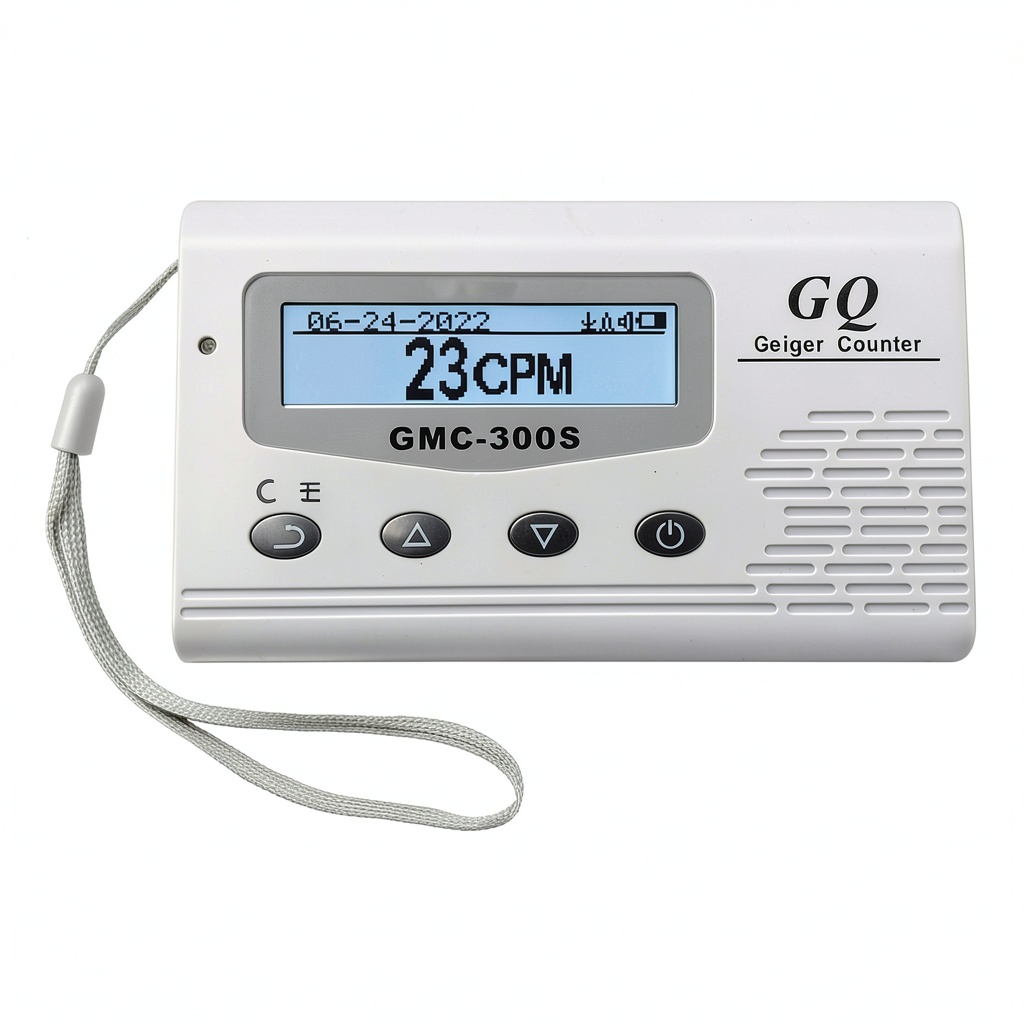 GQ GMC-300S Geiger Counter Radiation Detector Dosimeter on a wooden desk” />
Pros & Cons
Pros:
- Real Data Logging: The continuous logging to internal memory is a game-changer for monitoring.
- PC Software: The free software is robust, allowing for deep analysis of logged data.
- Cost-Effective: Offers features found in devices costing 2-3x more.
- Active Community: Strong online user community for troubleshooting and advanced tips.
- Multi-Unit Support: Switching between CPM, µSv/h, and mR/h is useful for different applications.
Cons:
- Calibration Dependent: Out-of-the-box dose rate (µSv/h) may not be accurate for your location; requires user calibration against a known source.
- Interface Complexity: Steep learning curve for those unfamiliar with radiation detection terminology.
- Limited Sensitivity: Cannot detect very low-level contamination that a scintillator-based detector might pick up.
- Build for Purpose: Plastic casing is not designed for harsh environments.
Comparison & Alternatives
To understand the GMC-300S’s place in the market, it’s essential to compare it to options both above and below its price point.
Cheaper Alternative: QuartaRad Radex One (Approx. $30-$50 less)
The Radex One is a popular entry-level Geiger counter. It’s simpler, often cheaper, and more straightforward for quick checks.
- Value Difference: The Radex One is a “point-and-read” device. It lacks data logging and PC connectivity. It’s better if you just want an instant yes/no on whether something is “hot.”
- When to Choose: Choose the Radex One if you are a casual user on a tight budget and have zero interest in tracking data over time. Choose the GMC-300S if you want to log data, analyze trends, or use it for educational purposes.
Premium Alternative: SOEKS EcoVisor F4 (Approx. $100+ more)
The SOEKS F4 is a multi-function device (Geiger counter, EMF meter, temperature, humidity) with a more polished user interface and color screen.
- Value Difference: The SOEKS is more user-friendly out of the box, with a simpler menu and additional sensors. However, its Geiger counter functionality may not be as transparent or customizable as the GMC-300S for purists.
- When to Choose: Choose the SOEKS F4 if you value a slicker interface, want additional environmental sensors, and prefer a more consumer-electronics experience. Stick with the GMC-300S if your primary focus is dedicated radiation data logging and you appreciate the ability to tinker with settings.
Buying Guide / Who Should Buy
Best for Beginners (with a caveat)
If you’re a beginner who is technically inclined and willing to spend a few hours reading the manual and online forums, the GMC-300S is a fantastic learning tool. The data logging will help you understand radiation in a way a simple counter cannot. If you’re a beginner who wants absolute simplicity, look for a more basic model.
Best for Professionals (as a secondary tool)
For professionals (e.g., health physicists, safety officers), this is not a primary instrument for compliance measurements. However, it’s excellent as a low-cost tool for preliminary scans, training exercises, or as a backup unit. Its data logging is useful for creating simple exposure records for non-critical areas.
Not Recommended For
First Responders: The device is not rugged enough for emergency response scenarios where it might be dropped or exposed to the elements.
Those Needing Certified Accuracy: If you require NIST-traceable calibration for legal or safety-compliance reasons, you need a professionally calibrated instrument from a brand like Thermo Fisher or Ludlum, which costs thousands.
The Technologically Averse: If the idea of connecting a device to a computer and adjusting settings sounds daunting, you will be frustrated.
FAQ
Is the GQ GMC-300S accurate right out of the box?
Its CPM (Counts Per Minute) reading is accurate for detecting relative changes. However, the dose rate conversion (µSv/h) is based on a default calibration that may not be precise for your specific environment. For the most accurate dose rate, you should calibrate it using a known source or compare its reading to a calibrated instrument in your area.
Can it detect radon gas directly?
No. Radon gas itself is difficult to detect directly with this type of instrument. However, the GMC-300S is effective at detecting the gamma radiation emitted by radon’s decay products (radon progeny) that plate out on surfaces. This is why long-term logging in a basement is a valid use case for screening.
How does it compare to a smartphone radiation app?
There is no comparison. Smartphone apps that claim to detect radiation using the camera sensor are notoriously unreliable and essentially useless. The GMC-300S uses a dedicated Geiger-Müller tube, which is the correct technology for the job.
Is the GMC-300S worth $48?
Absolutely, if you fall into the target user groups mentioned above. For the price, you are getting a functional, log-capable scientific instrument, not a toy. It provides real value for hobbyists, students, and preppers who want to move beyond basic detection into data analysis.
What’s the biggest limitation I should know about?
The most significant limitation is its inability to identify specific radioactive isotopes. It can tell you that radiation is present and at what approximate intensity, but it cannot distinguish between, say, Cesium-137 and Iodine-131. That requires a gamma spectrometer, which is a much more expensive piece of equipment.



 Whirlpool Washer Shock Absorber Genuine OEM Black WP8182703
  Monroe Shock Absorber Boot Kit Polyurethane Universal Fit