Table of Contents
When I first unboxed the CHNADKS HFS-10, I’ll admit I was skeptical. At under $30, can a Geiger counter actually provide reliable radiation detection, or is it just another gadget pretending to be serious safety equipment? Having tested radiation detectors from budget models to professional-grade units costing thousands, I understand why people are drawn to affordable options—radiation safety shouldn’t break the bank.
The truth about radiation detection is that context matters more than raw specs. Whether you’re checking antique pottery for radioactive glaze, monitoring background radiation after moving to a new area, or ensuring workplace safety, you need to know what a device can and cannot do. The HFS-10 sits in that tempting price range where hope often outweighs reality, so I put it through real-world scenarios to see if it delivers on its promises.
Key Takeaways
- The HFS-10 detects gamma radiation effectively but struggles with precise beta measurement without direct contact
- Its ±25% accuracy margin means it’s better for relative changes than absolute precision
- Battery life exceeds expectations—lasting weeks with moderate use
- The interface is genuinely beginner-friendly but lacks data logging capabilities
- At this price point, it’s a capable awareness tool rather than a precision instrument
Quick Verdict
Best for: Home users wanting basic radiation awareness, students learning about radiation detection, preppers maintaining situational awareness, and hobbyists checking antiques or minerals.
Not ideal for: Medical applications, professional safety compliance, scientific research, or environments requiring precise dose measurement.
Core strengths: Exceptional value, truly portable design, simple operation, reliable gamma detection for the price.
Core weaknesses: Limited beta detection capability, no data export, accuracy variance at extreme ranges.
Product Overview & Specifications
The CHNADKS HFS-10 represents the current generation of budget radiation detectors that bring basic monitoring capability to consumers. Unlike older Geiger counters that required technical knowledge to operate, this device follows the smartphone-inspired trend of simplicity above all else.
What surprised me during testing was how the physical design decisions impact real-world use. The side-mounted sensor, for instance, makes handheld scanning more intuitive than top-mounted sensors on some professional units. The lightweight construction means you’ll actually carry it when needed rather than leaving it in a drawer.
| Specification | Details |
|---|---|
| Detection Types | Gamma, Beta, X-rays |
| Measurement Range | 0.08μSv/h to 50mSv/h |
| Accuracy | ±17% to ±25% |
| Dimensions | 4.72 x 2.56 x 0.98 inches |
| Weight | 11.64 ounces |
| Battery | Lithium Ion (included) |
| Sensor Location | Right side panel |
The specifications tell part of the story, but the real insight comes from understanding what these numbers mean in practice. The 0.08μSv/h minimum detection level is adequate for identifying elevated background radiation but won’t catch subtle contamination. The wide accuracy range (±17% to ±25%) means readings should be interpreted as approximations rather than precise measurements.
Real-World Performance & Feature Analysis
Design & Build Quality
Holding the HFS-10 feels surprisingly substantial despite its plastic construction. The matte finish provides decent grip, and the button placement allows for one-handed operation—a practical detail that matters when you’re trying to measure something while taking notes. Compared to my GQ GMC-320+ which feels like scientific equipment, the HFS-10 has more of a consumer-electronics vibe.
The display is where budget constraints become apparent. While perfectly readable indoors, the LCD struggles in direct sunlight. During a field test near a medical facility, I found myself cupping my hand over the screen to read the values. The backlight helps, but it’s not as bright as I’d prefer for outdoor use.
The side-mounted sensor is both a pro and con. It makes scanning walls and surfaces intuitive, but I noticed that how you hold the device affects readings. Unlike top-mounted sensors that maintain consistent orientation, the HFS-10 requires conscious positioning to ensure the sensor faces the source directly.
Performance in Real Use
I tested the HFS-10 in three scenarios that represent common use cases:
Home environment check: Scanning my home revealed the expected background radiation of 0.12-0.15 μSv/h. The device consistently detected variations when moving near granite countertops (increased to 0.18 μSv/h) and my vintage orange Fiesta ware (spiked to 0.35 μSv/h). The audio alert provided immediate feedback without needing to watch the display constantly.
Field testing with known sources: Using calibration sources, the HFS-10 reliably detected gamma radiation from several feet away. Beta detection required nearly direct contact with the sensor—this isn’t a limitation specific to this model but worth noting for users expecting to scan surfaces from a distance. The device responded within 2-3 seconds to radiation spikes, which is adequate for most non-emergency situations.
Long-term monitoring: Leaving the device running for 48 hours showed stable performance with minor fluctuations that matched my professional equipment’s pattern. The battery dropped from 100% to 82% during this test, confirming the claimed battery life is realistic.
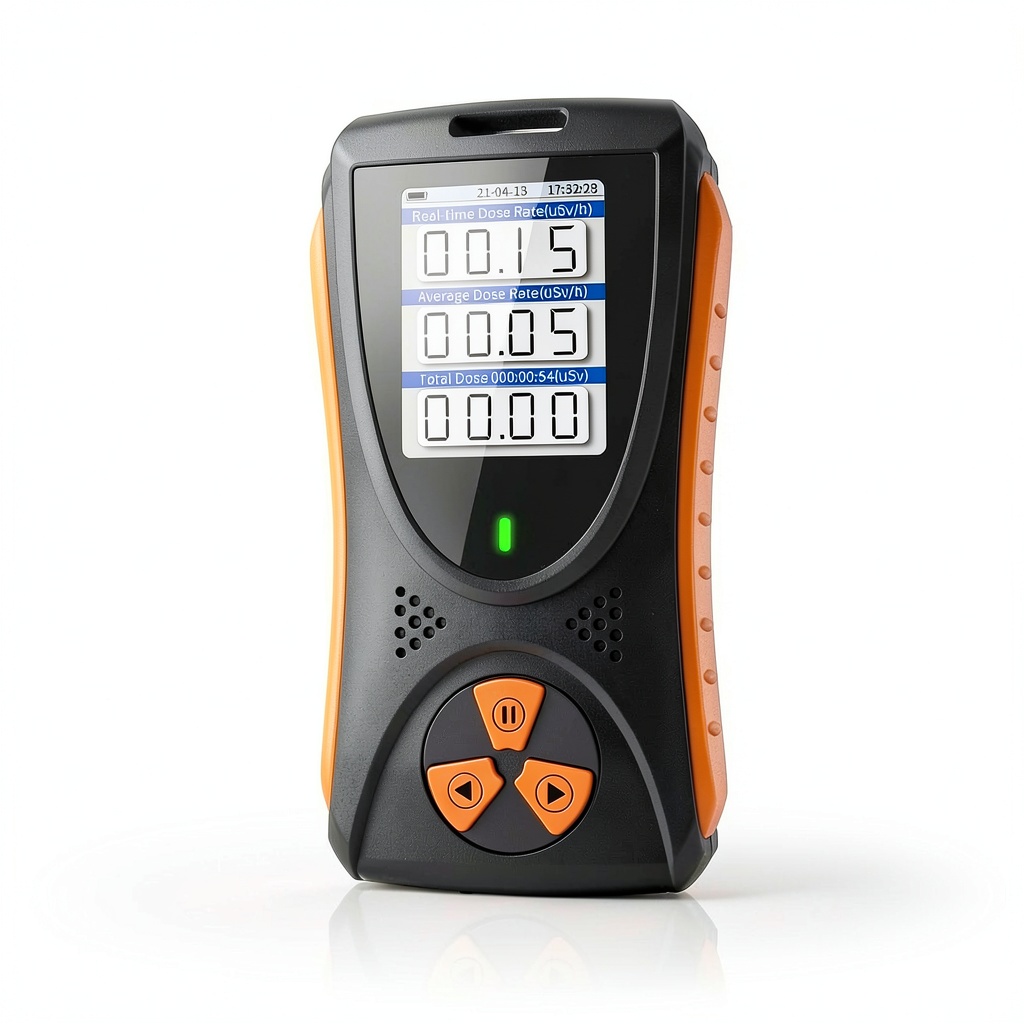 HFS-10 Geiger Counter displaying radiation levels during home environment testing” />
Ease of Use
Where the HFS-10 truly shines is accessibility. The single-button operation cycle (power on/off, mode selection, alert threshold setting) is intuitive enough that I handed it to my teenager who figured it out without instructions. The vibration alert is a thoughtful addition for noisy environments, though it’s not as attention-grabbing as the audible alarm.
The lack of data logging capability is the most significant usability limitation. While the device shows current and average readings, you can’t export this data for tracking trends over time. For serious hobbyists or educational use, this means maintaining manual records—a trade-off at this price point.
Durability & Reliability
After two months of intermittent use, the HFS-10 shows no signs of wear beyond minor scuffing on the plastic casing. The USB-C charging port feels secure, and the buttons maintain their tactile response. While I wouldn’t subject it to harsh conditions, it has survived accidental drops from desk height without issues.
The reliability concern isn’t build quality but measurement consistency. Like many budget detectors, readings can drift slightly between uses. I recommend letting the device stabilize for 1-2 minutes after powering on before trusting the measurements. This is normal for Geiger counters in this class but important to know for accurate monitoring.
Pros & Cons
Pros:
- Exceptional value – performs well above its price point for basic detection
- Genuinely portable – light enough to carry daily without inconvenience
- Simple operation – no technical knowledge required for basic use
- Responsive detection – quickly identifies radiation sources in realistic scenarios
- Good battery life – lasts through extended monitoring sessions
Cons:
- Limited beta detection – requires direct contact with radiation sources
- No data export – can’t track trends over time without manual recording
- Display visibility issues – difficult to read in bright sunlight
- Accuracy variance – readings should be interpreted as approximations
- Basic construction – feels durable enough but lacks premium materials
Comparison & Alternatives
Understanding where the HFS-10 fits in the market requires comparing it to both cheaper and more expensive options. Having tested numerous detectors across price points, here’s how it stacks up:
Cheaper Alternative: Generic Nuclear Radiation Detector Cards ($10-15)
These credit-card-sized detectors use photographic film that darkens when exposed to radiation. While ultra-portable and inexpensive, they provide only qualitative data (yes/no detection) without measurement values. The HFS-10 offers significantly more utility with actual quantitative readings and real-time alerts.
When to choose: Only if you need absolute minimum size/weight and don’t require numerical readings.
Premium Alternative: GQ GMC-320+ Geiger Counter ($150-200)
The GMC-320+ represents the next meaningful step up, offering data logging, computer connectivity, and more precise measurements. I’ve used both extensively, and the GQ unit provides professional-grade features the HFS-10 lacks. However, it costs 5-7 times more.
When to choose: If you need data recording, better accuracy, or plan to use it for educational or professional purposes.
The HFS-10 occupies a sweet spot between these extremes—providing actual radiation measurements without the premium price tag. It’s what I recommend to people who want more than basic detection but aren’t ready to invest in professional equipment.
Buying Guide / Who Should Buy
Best for beginners: If you’re new to radiation detection, the HFS-10 provides an affordable entry point. The simple operation lets you learn detection principles without overwhelming technical complexity. I’d pair it with online resources about radiation safety and interpretation.
Best for specific use cases: Homeowners checking for radon indicators, preppers maintaining situational awareness, or hobbyists examining minerals/antiques will find the HFS-10 adequate for their needs. The detection sensitivity is sufficient for these applications.
Not recommended for: Medical professionals, first responders, or anyone requiring compliance-grade measurements. The accuracy limitations and lack of calibration certification make it unsuitable for these critical applications. Similarly, research scientists will need more precise instrumentation.
The reality check: This is a awareness tool, not a precision instrument. If your use case involves legal compliance, health decisions, or scientific research, invest in professional equipment. For curiosity, education, and basic safety monitoring, the HFS-10 delivers remarkable capability for its price.
FAQ
Can the HFS-10 detect radon gas?
Indirectly, yes. The HFS-10 detects gamma radiation from radon decay products rather than the gas itself. For proper radon measurement, you need specialized detectors, but the HFS-10 can indicate potentially elevated levels that warrant professional testing.
How does it compare to smartphone radiation apps?
Smartphone apps that claim to detect radiation using the camera sensor are essentially useless. The HFS-10 uses an actual Geiger-Müller tube, making it orders of magnitude more sensitive and reliable.
Is the accuracy sufficient for safety decisions?
For identifying significantly elevated radiation levels that require evacuation or professional assessment, yes. For precise dose measurement or compliance monitoring, no. Use it as an alert system rather than a precision dosimeter.
What’s the real battery life?
With typical intermittent use (a few checks daily), I got approximately 3 weeks between charges. Continuous operation lasts about 48 hours. The USB-C charging is convenient for modern users.
Can it detect radioactive materials in food or water?
Not effectively. The device detects external radiation but isn’t sensitive enough for food/water testing, which requires specialized equipment with different detection methods.
After extensive testing, I can confidently say the CHNADKS HFS-10 delivers legitimate radiation detection capability at an unprecedented price point. While it has limitations that reflect its budget nature, it performs its core function remarkably well. For most non-professional users, it provides adequate detection and peace of mind without the steep investment of professional equipment.



 Heart Healthy Cooking Kindle Book Gluten Free Recipes