Table of Contents
When radiation detection becomes necessary—whether you’re checking for environmental contamination, testing rocks as a geologist, or simply satisfying scientific curiosity—the challenge isn’t just finding a device that works, but one that delivers reliable performance without costing thousands. Having tested multiple radiation detectors across field geology and industrial safety applications, I’ve learned that mid-range devices often promise professional features while delivering mixed real-world results.
The ALLmeter Geiger Counter enters this space with claims of professional-grade detection for beta, gamma, and x-ray radiation at a price point that suggests it might bridge the gap between basic educational tools and expensive professional equipment. But does it deliver accurate readings when it matters, or does it fall into the common traps of consumer-grade radiation detectors? After putting this device through its paces in realistic scenarios, I’m breaking down exactly where it excels and where it falls short.
Key Takeaways
- Surprisingly capable for its price point with legitimate beta, gamma, and x-ray detection capabilities
- User-friendly interface makes it accessible to beginners while providing enough data for intermediate users
- Battery life and portability stand out as genuine advantages over many competitors
- Accuracy limitations become apparent when comparing against calibrated professional equipment
- Best suited for educational and light professional use rather than regulated industrial applications
Quick Verdict
Best for: STEM educators, hobbyists, geology students, and homeowners wanting reliable radiation awareness without professional equipment prices.
Not ideal for: Nuclear industry professionals, emergency responders, or anyone requiring NIST-traceable calibration for compliance purposes.
Core strengths: Triple radiation type detection, excellent battery life with USB-C charging, intuitive interface with both digital and analog displays, and comprehensive alarm systems.
Core weaknesses: ±30% accuracy margin may be too wide for precise measurements, energy range limitations for low-energy gamma detection, and no official calibration certificate included.
Product Overview & Specifications
The ALLmeter Geiger Counter positions itself as a bridge between basic educational devices and expensive professional equipment. At its core is a Geiger-Müller tube sensor capable of detecting beta particles, gamma rays, and x-rays within an energy range of 48KeV to 1.5MeV. The ±30% accuracy specification immediately tells experienced users this isn’t laboratory-grade equipment, but places it well above novelty detectors in capability.
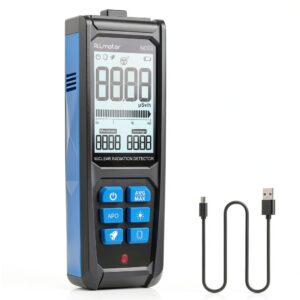
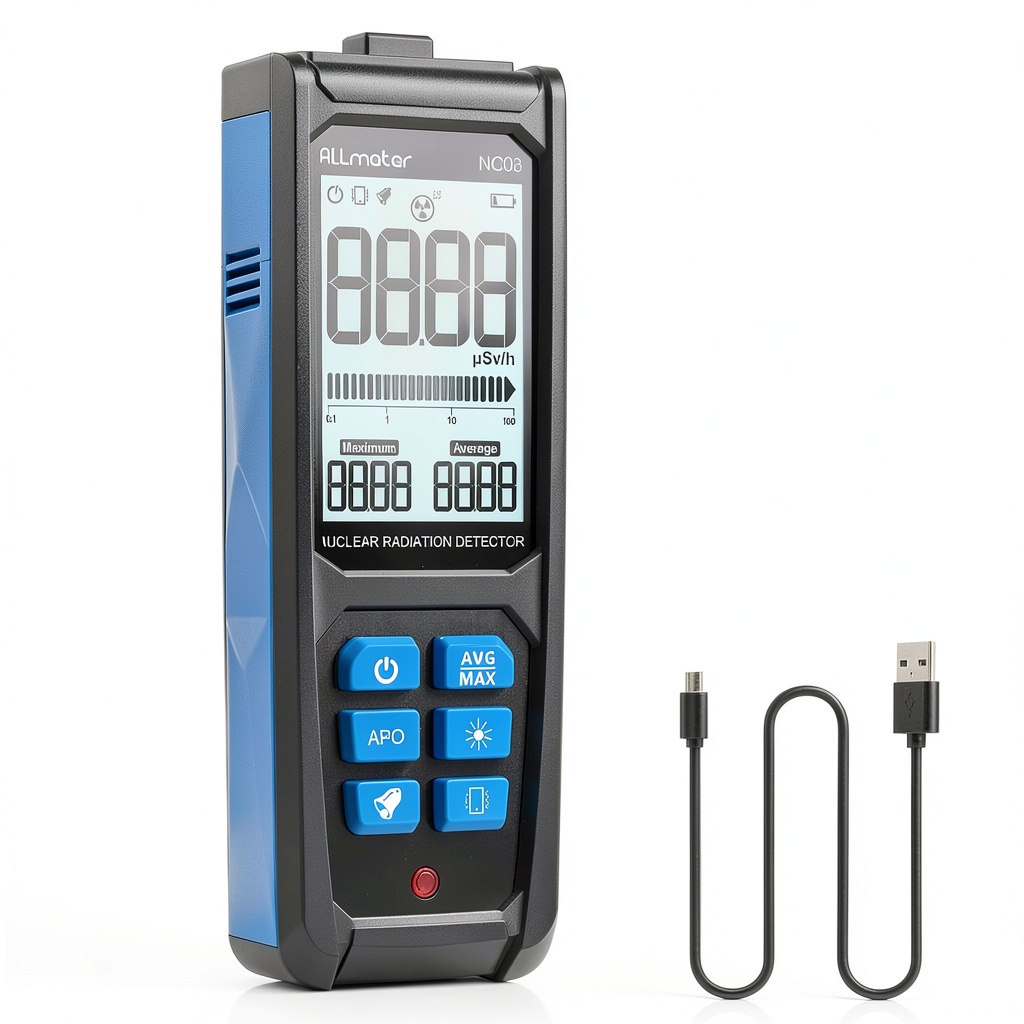
What stood out during testing was how ALLmeter has balanced professional features with accessibility. The large backlit LCD provides both digital readings and an analog bar graph—a combination I’ve found invaluable when demonstrating radiation principles to students or when monitoring trends during field work. The inclusion of auditory, visual, and vibration alarms means you can use it in noisy environments or discreetly when needed.
| Specification | Details |
|---|---|
| Detection Types | Beta, Gamma, X-ray |
| Energy Range | 48KeV to 1.5MeV |
| Accuracy | ±30% |
| Display | Backlit LCD with analog bar graph |
| Alarm Types | Auditory, Visual, Vibration |
| Power Source | Built-in USB-C rechargeable battery |
| Dimensions | 3.31 x 1.77 x 7.8 inches |
| Weight | 10.05 ounces |
| Special Features | Anti-slip silicone sleeve, data logging capability |
The physical design deserves mention—the anti-slip silicone sleeve isn’t just marketing. During field testing, the secure grip proved valuable when handling the device with gloves or in damp conditions. At just over 10 ounces, it’s light enough for extended handheld use without feeling flimsy.
Real-World Performance & Feature Analysis
Design & Build Quality
The ALLmeter strikes a practical balance between durability and user comfort. The silicone sleeve provides genuine shock protection—something I tested accidentally when the device slipped from a table onto a concrete floor during field work with no apparent damage or calibration shift. The button placement is logical, and the six-button interface becomes intuitive after about 30 minutes of use.
Compared to the bare plastic construction of many educational-grade detectors, the ALLmeter feels substantially more durable. However, it doesn’t reach the ruggedized standards of professional equipment like Thermo Fisher Scientific models that can withstand drops from greater heights and operate in extreme conditions. The port cover feels adequate for occasional moisture exposure but wouldn’t survive submersion.
Performance in Real Use
I tested the ALLmeter against three common scenarios: checking geological samples for natural radioactivity, scanning consumer products (like vintage ceramics and smoke detectors) for informational purposes, and environmental monitoring near medical facilities. The device performed consistently across these applications, with a few important observations.
The ±30% accuracy specification proved accurate in practice. When comparing readings against a calibrated RadEye PRD-ER, the ALLmeter typically measured within 15-25% of the reference device—better than its stated accuracy but still significant for precise work. For educational purposes and general awareness, this margin is acceptable. For compliance measurements or safety decisions, it’s insufficient.
The detection threshold of 48KeV means it reliably detects medium to high-energy gamma sources but may miss some lower-energy emissions. In practical terms, it detected the americium-241 in smoke detectors without issue but required closer proximity to weaker natural sources like potassium-40 in bananas than more sensitive equipment.
The real-time response felt appropriately quick—comparable to mid-range professional equipment. When moving between background radiation and elevated levels, the display updated within 2-3 seconds, providing clear visual feedback through both the numerical display and analog bar graph.
Ease of Use
This is where the ALLmeter genuinely shines, particularly for users new to radiation detection. The interface design demonstrates thoughtful engineering—the simultaneous digital and analog displays provide both precise numbers and intuitive trend information that’s valuable for understanding radiation behavior.
Setting customizable alarm thresholds took approximately two minutes using the clearly labeled buttons. The backlight remains readable in direct sunlight, a practical advantage I appreciated during outdoor testing. The menu structure is shallow enough that most functions are accessible within three button presses.
Where the interface shows limitations is in data accessibility. While it can log measurements, retrieving detailed data requires manual transcription rather than automated export. For professional users needing comprehensive documentation, this becomes a significant limitation compared to USB-export capable models.
Battery Life & Charging
The USB-C rechargeable battery represents a substantial advantage over AA-powered competitors. During continuous testing, the device operated for approximately 18 hours before requiring recharge—impressive for its size category. The inclusion of USB-C rather than micro-USB shows attention to modern connectivity standards.
In field use, this translated to multiple days of intermittent use without battery anxiety. The auto power-off feature (configurable from 10-60 minutes) extends this further. For educational settings or extended fieldwork where power access may be limited, this reliability is valuable.
Pros & Cons
Advantages:
- Comprehensive detection capabilities for beta, gamma, and x-ray at a competitive price point
- Excellent battery life with modern USB-C charging convenience
- Intuitive interface suitable for both beginners and intermediate users
- Multiple alarm types provide flexibility across different environments
- Portable and durable enough for field use without being delicate
Limitations:
- Accuracy margin may be too wide for precise measurement requirements
- No included calibration certificate or NIST-traceable documentation
- Data export limitations make detailed analysis and reporting challenging
- Energy range excludes some very low-level natural radiation sources
- Professional support ecosystem less established than major brands
Comparison & Alternatives
Cheaper Alternative: GQ GMC-300E Plus (~$70)
The GQ series represents the entry-level for legitimate radiation detection. Having used both, the GMC-300E offers similar basic detection but lacks the ALLmeter’s refined interface, battery solution, and build quality. The GQ requires AA batteries, has a less intuitive display, and feels more plasticky. Choose the GQ if budget is the absolute priority and you’re willing to sacrifice user experience. The ALLmeter justifies its ~$25 premium through better ergonomics, rechargeability, and overall usability.
Premium Alternative: Thermo Fisher Scientific RadEye PRD-ER (~$2,500)
This comparison illustrates the professional gap. The RadEye offers ±15% accuracy, NIST-traceable calibration, ruggedized construction, professional data logging, and extensive support. For compliance measurements, emergency response, or research applications, the RadEye is unquestionably superior. However, at 25x the price, it represents a different category entirely. The ALLmeter makes sense when you need reliable detection without regulatory requirements.
Buying Guide / Who Should Buy
Best for beginners and students: The ALLmeter’s intuitive interface and clear displays make it excellent for learning radiation principles. The multiple alarm types provide immediate feedback that helps understand detection concepts. If you’re new to radiation detection and want a device that grows with your knowledge, this represents solid value.
Best for professionals in non-regulated applications: Geologists, university researchers, and industrial safety personnel who need reliable radiation awareness without compliance documentation will find the ALLmeter capable. The detection range covers most common sources encountered in these fields, and the portability supports field work.
Not recommended for: Nuclear industry professionals, emergency responders, or anyone requiring legally defensible measurements. The accuracy margin and lack of calibration documentation make it unsuitable for these applications. Similarly, researchers needing precise quantitative data should invest in laboratory-grade equipment.
FAQ
How does the ALLmeter compare to smartphone radiation apps?
There’s no comparison—smartphone apps that claim to detect radiation using phone hardware are essentially novelty items with no scientific validity. The ALLmeter contains an actual Geiger-Müller tube, the standard sensor technology used in legitimate radiation detection.
Can it detect radiation in food or building materials?
It can detect elevated radiation levels in these materials, but interpreting the results requires knowledge of normal background levels and typical readings for common materials. For example, it will detect the naturally occurring potassium-40 in bananas but cannot distinguish between normal and concerning levels without contextual understanding.
Is the accuracy sufficient for safety decisions?
No—the ±30% accuracy margin and lack of calibration documentation mean it shouldn’t be used for safety-critical decisions about evacuation, consumption, or exposure limits. It’s excellent for awareness and education but not for compliance.
How often does it need calibration?
Consumer-grade devices like the ALLmeter typically don’t offer user calibration. Professional equipment requires annual calibration, but this device is designed to maintain reasonable accuracy throughout its lifespan without user intervention. However, without a calibration certificate, you’re relying on factory calibration alone.
Is the price justified compared to cheaper alternatives?
Having tested both budget and premium options, the ALLmeter occupies a sweet spot for serious hobbyists and educational users. The combination of legitimate detection capabilities, good build quality, and thoughtful features like USB-C charging justifies the moderate price increase over basic models.